
Why Most Omega-3 Supplements Never Reach Your Brain
2nd Jun 2026
There’s a well-established paradox in brain health research. Eating more dietary omega-3s, particularly from fish and seafood, is consistently associated with lower rates of cognitive decline and better long-term brain function. Yet large clinical trials using omega-3 supplements keep returning weak, mixed, or outright disappointing results.
If omega-3s are good for the brain, why don't most omega-3 supplements work? The answer is not about dose. It is about molecular form and delivery.

The Paradox in the Research
Decades of dietary research establish a clear pattern: populations with high fish and seafood consumption show lower rates of cognitive decline and better long-term brain function. The epidemiology is consistent across continents, study designs, and decades.
The clinical trial data on omega-3 supplements tells a different story. Large, well-funded trials using conventional fish oil, krill oil, and ethyl ester formulations have returned weak, mixed, or null results for cognitive outcomes.
If omega-3s are essential for brain health, why do supplements consistently fail to replicate what diet achieves? The answer is not about dose. It is about molecular form.
Eating fatty fish is consistently associated with lower rates of cognitive decline. Taking a fish oil supplement is not. The difference isn’t dose. It is chemistry.
The Blood-Brain Barrier Is Not a Passive Filter
The brain is the most protected organ in the body. The blood-brain barrier (BBB) is an active, highly selective system that controls precisely what enters and what does not. It does not accept nutrients in arbitrary form. It transports specific molecular structures via dedicated protein channels.
Omega-3 fatty acids, including DHA (docosahexaenoic acid) and EPA (eicosapentaenoic acid), are essential for brain structure and cognitive function. The brain cannot synthesize them. It must obtain them from an external source. But here’s the critical detail most supplement labels never mention: the brain can only take up DHA in one specific molecular form.
That form is lysophosphatidylcholine, or LPC.
LPC-bound DHA is the primary and most efficient form for crossing the blood-brain barrier, via a dedicated transport protein called MFSD2A (Major Facilitator Superfamily Domain-Containing Protein 2A). This mechanism was identified and confirmed in a landmark 2014 study by Dr. David Silver and colleagues at Duke-NUS Medical School, Singapore.
TAG-DHA (triacylglycerol-bound DHA) – the form found in standard fish oil and most krill oil supplements – can cross by secondary routes, but at a fraction of the rate, not enough to meaningfully enrich the brain. Without LPC as its carrier, most DHA enters systemic circulation, accumulates in fatty tissue and peripheral organs, and doesn’t reach the neurons it was taken to support.
This is the structural reason why dietary fish outperforms fish oil capsules. Seafood, particularly fish roe, salmon, and herring, contains omega-3s naturally bound in phospholipid form. Standard fish oil supplements, ethyl esters, and triglyceride-form omega-3s do not.
We know this pathway is not optional. When MFSD2A function is lost or severely impaired in humans, the consequences are catastrophic – from serious neurodevelopmental damage to fatal brain malformation. The evidence does not get more definitive than that.
What the Evidence Shows
This is not a theoretical gap. The research directly comparing molecular forms is unambiguous.
In a preclinical animal study, Sugasini et al. (Journal of Nutritional Biochemistry, 2019) demonstrated that when animals were given equivalent doses of DHA in different molecular forms, LPC-DHA significantly increased brain DHA concentrations. Triglyceride-form DHA accumulated preferentially in adipose tissue and produced no meaningful increase in brain levels.
In a mouse study published in Scientific Reports, Sugasini et al. (2017) found that dietary LPC-DHA enriched brain DHA and improved memory performance in adult mice. TAG-DHA at equivalent doses did not.
The structural basis of this transport was confirmed at the molecular level in a 2021 Nature paper by Cater et al. The mechanism is not contested. It is established biochemistry.
The practical implication: supplementing with the wrong molecular form of DHA is not a partial solution. It is a different biological outcome.
Why This Becomes More Significant Over Time
Preclinical evidence suggests that MFSD2A transporter activity in the brain declines with age – demonstrated in mouse studies showing reduced MFSD2A expression in brain microvasculature (Iwao et al., PLoS One, 2023).
This means the brain becomes progressively less efficient at taking up LPC-DHA from dietary sources, even when those sources are adequate. Oxidative damage to neuron membranes accumulates faster than repair pathways can address it.
The result is the gradual cognitive decline that is often attributed simply to getting older. In physiological terms, it reflects a specific, addressable deficit in delivery.
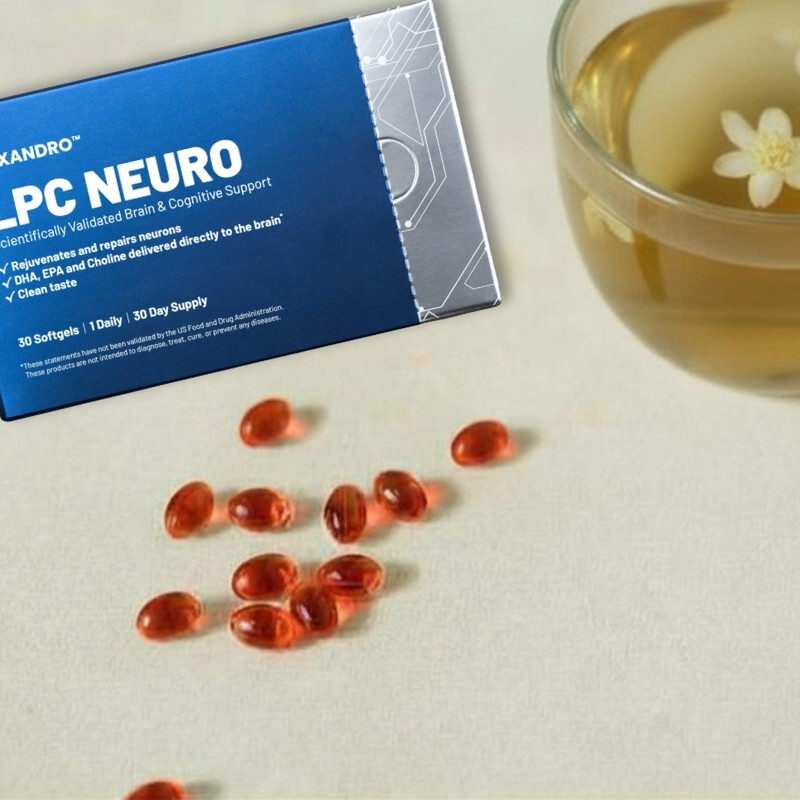
LPC Neuro: Formulated for the Right Pathway
XANDRO® Lab formulates LPC Neuro in response to this specific gap in the research. It is formulated with Lysoveta™, a patented LPC-rich oil derived from sustainably harvested Antarctic krill, developed in scientific collaboration with Prof. David Silver of Duke-NUS Medical School.
Each serving provides 500 mg of Lysoveta, supplying 115 mg of LPC and 130 mg of total omega-3 fatty acids, including EPA and DHA in phospholipid-bound form. Astaxanthin antioxidant is also present naturally. In animal studies, LPC-DHA significantly increased retinal DHA concentrations via the same delivery pathway, suggesting a potential application for supporting retinal health (Sugasini et al., Nutrients, 2020).
Lysoveta may help relieve dry eye symptoms. In a preliminary clinical study (n=17), participants taking one 500 mg softgel of Lysoveta daily reported an average 26-point improvement on the OSDI, a validated measure of dry eye symptom severity, within four weeks.
LPC Neuro is third-party tested for purity, free from heavy metals and contaminants. Lysoveta is Marine Stewardship Council-certified, sourced from the only A-rated reduction fishery recognized by the Sustainable Fisheries Partnership.
The biology of the long game favors precision over volume. Supplementing with the right form of DHA, via the pathway the brain actually uses, is not a refinement. It is the difference between accumulation and delivery.
The Practical Position
Standard omega-3 supplements are not without value. Fish oil and krill oil support cardiovascular health and help reduce systemic inflammation – these are real, well-documented benefits. The argument here is more specific: for delivering DHA to the brain, molecular form is the deciding variable, and standard formulations are not built for that purpose.
Eating fatty fish regularly remains one of the most consistent dietary behaviors associated with cognitive longevity – in part because fish naturally contains phospholipid-form omega-3s that standard supplements do not replicate. For most people, dietary LPC-DHA intake is insufficient, particularly as MFSD2A activity declines with age.
Supplementing with the molecular form the brain is designed to receive is not a workaround. It is the physiologically correct approach. Most omega-3 supplements are not formulated to this specification. LPC Neuro is.
Age powerfully.
LPC Neuro is a health supplement produced by XANDRO Lab. It is not intended to diagnose, treat, cure, or prevent any disease. Always consult a qualified healthcare professional before starting any supplement, particularly if you are taking prescription medications, managing a health condition, or are pregnant or breastfeeding.
FAQs
Why don't standard omega-3 supplements work for the brain?
Most omega-3 supplements deliver DHA in triglyceride or ethyl ester form. The brain cannot efficiently absorb DHA in this form – it requires DHA bound to a specific carrier molecule called lysophosphatidylcholine (LPC) to cross the blood-brain barrier via the MFSD2A transporter. Without that carrier, most DHA circulates systemically and accumulates in fat tissue and peripheral organs rather than reaching the neurons that need it. The dose is not the problem. The molecular form is.
Is krill oil better than fish oil for brain health?
Krill oil is often marketed as superior because it contains DHA in phospholipid form rather than triglycerides. That distinction matters for systemic absorption – but not meaningfully for brain delivery. The phospholipid in standard krill oil is phosphatidylcholine (PC). In animal studies, untreated krill oil produced limited brain DHA enrichment – approximately 5-fold less than lipase-treated krill oil, which generates LPC-DHA. Fish oil, whether lipase-treated or not, had no significant effect on brain DHA (Yalagala et al., Mol Nutr Food Res, 2020). The MFSD2A transport pathway is most efficiently used by DHA delivered as LPC. Standard krill oil does not supply LPC-DHA. Lysoveta, the ingredient in LPC Neuro, does.
What is LPC-DHA and why does it matter?
LPC-DHA is docosahexaenoic acid bound to a lysophosphatidylcholine carrier molecule. It is the molecular form the brain is designed to receive. The MFSD2A transporter at the blood-brain barrier specifically recognizes and transports LPC-DHA – a mechanism confirmed in a landmark 2014 study at Duke-NUS Medical School. Most dietary omega-3 sources, including standard fish oil and krill oil, do not supply DHA in this form. Fatty fish, particularly fish roe, salmon, and herring, do – which is a significant reason why dietary fish intake consistently outperforms supplements in cognitive research.
Does LPC Neuro replace my regular omega-3 supplement?
LPC Neuro is specifically formulated for brain and retinal DHA delivery. If you are taking a standard omega-3 for cardiovascular or anti-inflammatory support, that supplement serves a different purpose and the two can be taken alongside each other. If brain health and cognitive longevity are the primary goal, LPC Neuro addresses the delivery gap that standard formulations do not. As with any supplement regimen, consult your healthcare provider.
Can I get enough LPC-DHA from diet alone?
Dietary sources of LPC-DHA – primarily fish roe, herring, and salmon – do provide naturally occurring phospholipid-bound omega-3s. However, achieving consistent, meaningful LPC-DHA intake through diet alone is difficult for most people, and becomes progressively harder as MFSD2A transporter activity in the brain declines with age. Regular fatty fish consumption is beneficial and worth maintaining. For individuals who cannot eat fatty fish consistently, or who are in their 40s and beyond when transporter efficiency is declining, dietary intake alone is typically insufficient to maintain optimal brain DHA concentrations.
Why does this matter more as you get older?
Preclinical evidence from animal studies suggests MFSD2A transporter activity at the blood-brain barrier decreases with age, with mouse studies (Iwao et al., PLoS One, 2023) showing reduced MFSD2A expression in brain microvasculature in middle-aged and older animals. This means the brain becomes progressively less efficient at taking up DHA from dietary sources, even when intake is adequate. The result is a gradual, addressable decline in the brain’s capacity to maintain optimal DHA concentrations.
References
Nguyen LN et al. Mfsd2a is a transporter for the essential omega-3 fatty acid docosahexaenoic acid. Nature. 2014;509(7501):503-6.
Guemez-Gamboa A et al. Inactivating mutations in MFSD2A, required for omega-3 fatty acid transport in brain, cause a lethal microcephaly syndrome. Nat Genet. 2015;47(7):809-13.
Alakbarzade V et al. A partially inactivating mutation in the sodium-dependent lysophosphatidylcholine transporter MFSD2A causes a non-lethal microcephaly syndrome. Nat Genet. 2015;47(7):814-7.
Cater RJ et al. Structural basis of omega-3 fatty acid transport across the blood-brain barrier. Nature. 2021;595(7866):315-319.
Sugasini D et al. Dietary docosahexaenoic acid (DHA) as lysophosphatidylcholine, but not as free acid, enriches brain DHA and improves memory in adult mice. Sci Rep. 2017;7(1):11263.
Sugasini D et al. Enrichment of brain docosahexaenoic acid (DHA) is highly dependent upon the molecular carrier of dietary DHA. J Nutr Biochem. 2019;74:108231.
Sugasini D et al. Efficient Enrichment of Retinal DHA with Dietary Lysophosphatidylcholine-DHA. Nutrients. 2020;12(10):3114.
Scheinman SB et al. LPC-DHA/EPA-Enriched Diets Increase Brain DHA and Modulate Behavior in Mice That Express Human APOE4. Front Neurosci. 2021;15:690410.
Yalagala PCR et al. Dietary lysophosphatidylcholine-EPA enriches both EPA and DHA in the brain: potential treatment for depression. J Lipid Res. 2019;60(3):566-578.
Hachem M et al. Efficient Docosahexaenoic Acid Uptake by the Brain from a Structured Phospholipid. Mol Neurobiol. 2016;53(5):3205-3215.