

Your brain is your longest-running investment: Why cognitive decline isn’t inevitable
7th Jul 2026
You may already feel something is shifting… the name you can’t quite retrieve in a meeting. The focus that used to carry you through an afternoon and now fades by 3 pm. The sense that your thinking isn’t quite as sharp as it was five years ago.
Most people joke about it – "just getting old". But beneath the humor sits a real question: is this simply the cost of a demanding life, or the beginning of a longer, maybe more serious slide? And is there anything you can actually do about it?
What research says about cognitive decline
These kinds of everyday lapses can have many causes – poor sleep, stress, aging, hormonal changes, nutritional gaps, or simply the demands of a busy life. They are not necessarily signs of anything clinical. But they do reflect how the brain is functioning day to day. The brain, like any other biological system, responds to how it is treated over time.
The largest review of the evidence to date – the 2024 Lancet Commission – estimated that around 45 percent of long-term cognitive risk may be attributable to factors that can be acted on across the lifespan – these include physical inactivity, cardiovascular health, social isolation, excessive alcohol intake and smoking.1
Separately, a 25-year cohort study linked persistently short sleep to a 30 percent higher risk of cognitive decline in later life.2
The broader picture is worth bearing in mind, too. A 2025 study in Nature Medicine followed approximately 15,000 US adults over decades. Within that population, the estimated lifetime risk of dementia after age 55 was around 42 percent.3 That is a large-scale number, and individual risk varies widely. But it underlines why the modifiable factors above matter – and why acting on them early is not overcaution.
The message is not that everyday forgetfulness is a warning sign. It is that cognitive function – from daily sharpness to long-term resilience – responds to deliberate management. And the earlier you start, the more there is to build on.
Which raises a different question: are you managing your brain deliberately, over decades, the way you would manage any other long-term investment?
The problem with how most people approach brain health
Many people who think about brain health at all tend to address one aspect of it. They take an omega-3 supplement and assume the job is done. They do crossword puzzles and call it “keeping the brain sharp.” They accept poor sleep as the cost of an ambitious life and address it, if at all, as a separate problem from cognition.
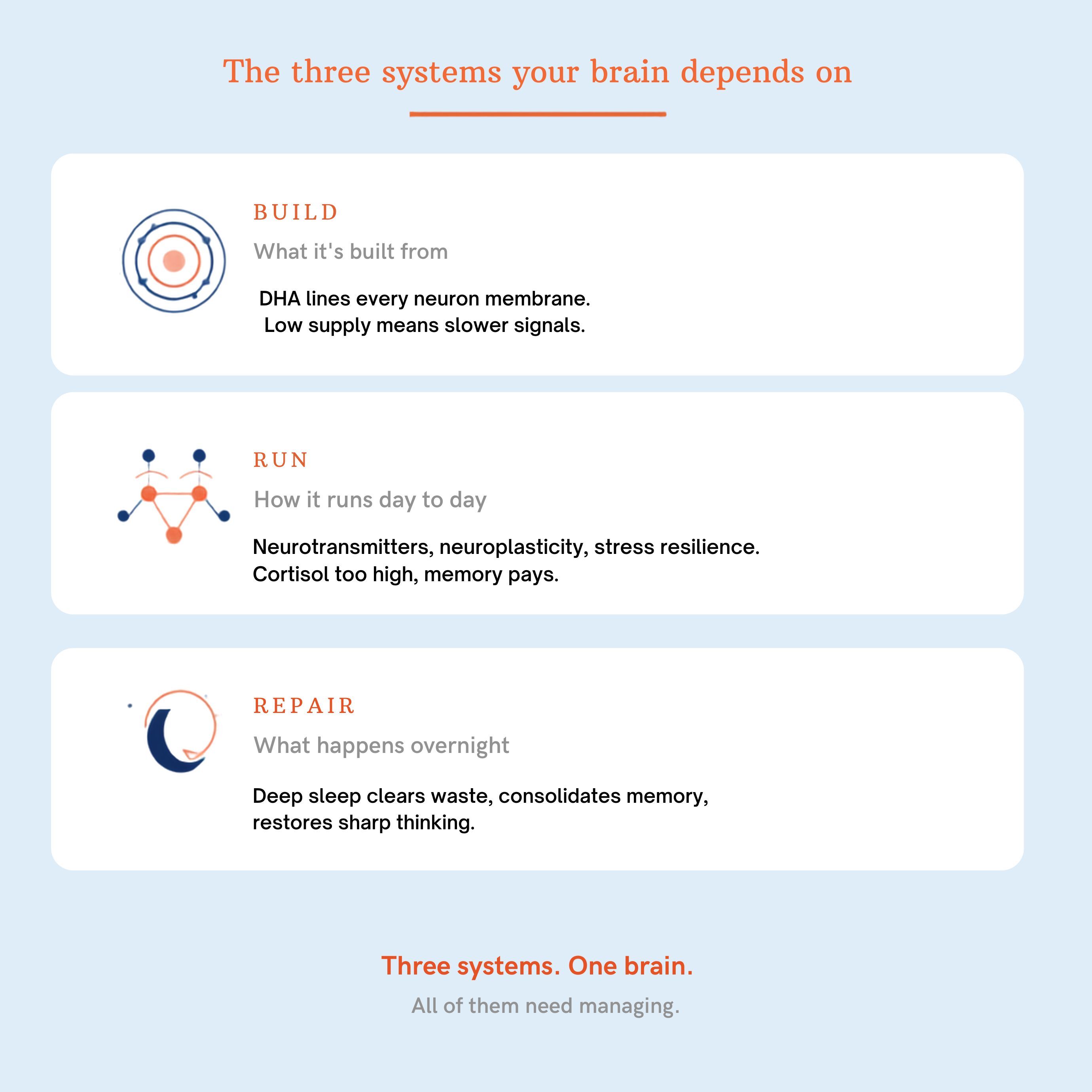
Here is the issue: cognitive function is not one-dimensional. It depends on:
- the physical structure of brain cells – the material neurons are built from4
- the chemical signaling between them, and on how the nervous system handles pressure5
- and on what happens to the brain overnight while you sleep2
This matters whether you are a 45-year-old executive optimizing for the next decade of performance, or someone in your sixties who has noticed that recall isn’t quite what it used to be.
The science: What your brain actually runs on
Each of those three dimensions works differently, responds to different inputs, and shows up differently when it's neglected. Here's what's actually happening under the surface.
What it’s built from.
The brain is one of the most lipid-rich organs in the body, and the single most abundant polyunsaturated fatty acid in its structure is an omega-3 called DHA.4 DHA sits in the outer membrane of every neuron (the brain cells responsible for carrying signals)– letting signals pass cleanly from one brain cell to the next.
When there’s enough DHA, signals travel cleanly. When there isn’t, they don’t. That’s the difference between sharp recall and the name that hovers just out of reach.
It is less about fuel and more about construction material – like asking whether a building’s wiring can carry a signal when the walls themselves are thinning.
How it runs day to day.
This is the part most people mean by "brain health": focus, recall, getting through demanding work without running out of steam by mid-afternoon.
It depends on three things working well together:
First, the chemical messengers that carry signals between neurons.
Second, the brain's ongoing ability to build and strengthen connections – a process called neuroplasticity, essentially the brain's capacity to adapt with use, the way muscle adapts to training.
And third, how the nervous system handles pressure.
This last one deserves a closer look. When cortisol – the body’s main stress hormone – remains elevated over time, it does more than make you feel stressed. It affects how you think. Research has linked persistently high cortisol to physical changes in the parts of the brain responsible for memory.5
When people say "I’m so stressed I can’t think straight," they are describing something the research now supports. It’s as if your brain’s decision-making center gets a demotion, while the alarm system gets a promotion. The clear-headed version of you is still in there. It’s just harder to reach.
What happens overnight.
Sleep is the time when the brain does its housekeeping. During deep sleep, it clears out metabolic waste that builds up during the day – including a protein called beta-amyloid, which accumulates measurably in key brain regions after even a single night of poor sleep.6
Animal research has identified the likely mechanism: the spaces between brain cells expand significantly during sleep, allowing a flush of fluid that carries waste products, including beta-amyloid, out of the brain.7
The brain also files the day’s experiences into memory during these overnight hours.
The 25-year study of nearly 8,000 adults found that sleeping six hours or less at age 50 and 60 was associated with a higher rate of dementia later in life, compared with sleeping around seven hours, and that this pattern, sustained across decades, was linked to a 30 percent higher overall risk, independent of other health factors.2 It is an observational study, so it shows a pattern rather than proof of cause and effect – but the pattern held for 25 years.
In practical terms: the foggy morning after a bad night is not just low energy. It is uncleared waste, unconsolidated memories, and a prefrontal cortex running below capacity. You recover from one bad night. But when poor sleep becomes a pattern, the effects compound.
Cognitive function – from daily sharpness to long-term resilience – responds to deliberate management.
And the earlier you start, the more there is to build on.
The trial that showed cognitive decline can be slowed
The clearest proof that brain health responds to deliberate effort comes from the FINGER trial, a two-year randomized controlled trial of more than 1,200 older adults already at elevated risk of cognitive decline.8
One group followed a structured program combining diet changes, exercise, cognitive training, and management of cardiovascular risk factors. By the end of the trial, this group scored significantly better on a battery of cognitive tests than the group that did not.8
The detail worth thinking about: this was not one intervention. It was several, delivered together, to people who were already at risk – and it worked. FINGER has since become the model for a global network of similar trials, now spanning over 40 countries.9
Put the numbers side by side, and a pattern emerges. The 42 percent lifetime risk figure is real.3 So is the finding that around 45 percent of cases trace back to factors you can act on.1 And FINGER shows that acting on several of those factors together, consistently, changes outcomes – even in people already considered at risk. None of this is about undoing what has already happened. It is about which direction things go from here.8
What actually matters – At 40, 50, and 60
The modifiable risk factors identified by the Lancet Commission span early life, midlife, and later life.1 There is no age before which it is too early to start, and no age at which it stops being worth addressing. But midlife – the 40s and 50s – is when several of the most significant factors, including cardiovascular health and physical activity, are most actionable.1
Independent of any product, a few things consistently show up in the research as relevant to long-term cognitive function:
Sleep duration and quality. Aim for the range your body actually needs – as the Sleep Foundation notes, typically around seven hours for most adults – rather than treating sleep as the most flexible item in your schedule.2
Omega-3 intake, particularly DHA. Given how much of the brain’s structure depends on it, dietary intake (oily fish, or a supplement that addresses absorption) is worth getting right – not as a one-time fix, but as an ongoing input.4
Cardiovascular health. Several of the 14 modifiable risk factors identified by the 2024 Lancet Commission – including high blood pressure, high LDL cholesterol, and physical inactivity – are cardiovascular in nature.1 What is good for the heart is, in this case, good for the brain, according to the WHO.
Cognitive engagement and social connection. Sustained mental engagement and social interaction are both part of the modifiable risk factor set identified in the Commission’s review.1
Stress management. Chronic, unmanaged stress affects the day-to-day operating system described above.5 This does not mean eliminating stress – it means having a way to bring the nervous system back down regularly.
None of this requires waiting until symptoms appear. The asset is easiest to protect while it is still strong.
A systematic approach to Cognitive Biocap
We at XANDRO think about long-term health in terms of Biological Capital or Biocap – the underlying physical and cognitive reserves that determine how well you function not just today, but ten and twenty years from now. Cognitive function is one of the core components of that capital, and like any asset, it responds to how consistently it is managed.
Given the three things above – build, run, repair – we built our approach to brain health around supporting each one, rather than picking a single point of intervention.

Our cognitive powerhouse trio
1. LPC Neuro is built around providing the brain with its raw materials.
LPC Neuro uses Lysoveta™, a form of DHA bound to LPC (lysophosphatidylcholine) – and the reason that binding matters is the blood-brain barrier. The brain is highly selective about what it lets in. Standard omega-3 supplements deliver DHA in forms – typically triglycerides or ethyl esters – that cross this barrier poorly. Most of that DHA ends up distributed elsewhere in the body rather than reaching the organ that needs it most.
The brain has its own dedicated uptake pathway, a transporter called MFSD2A, that preferentially accepts DHA when it arrives bound to LPC. Lysoveta is designed to use that pathway directly, so more of the DHA reaches the brain rather than stopping at the gate.
We covered the delivery mechanism in detail in our earlier piece on why most omega-3 supplements never reach the brain.
The next post in this series looks at what happens when the brain runs short on DHA in the first place.
2. Neuro X is built around the day-to-day running of the brain.
Neuro X is formulated to support focus, recall, and mental stamina, including how the nervous system handles pressure, without relying on stimulants. We introduced the full formulation in our Neuro X launch post.
3. Sleep On is built around overnight repair.
Sleep On is formulated to support the body’s own sleep timing signal, help calm an overactive nervous system at night, and support the conditions the brain needs for its overnight maintenance cycle.
A later post in this series looks specifically at the sleep-cognition connection.
One system, not three separate fixes
In plain terms: feeding the brain the right building material while neglecting its daily operating conditions, or supporting daily performance while undermining the overnight repair window, means progress in one area gets undone by neglect in another.
Build, run, repair are not three separate priorities. They are one system.
Frequently Asked Questions
Is cognitive decline inevitable as you age?
Some degree of change in processing speed is a normal part of aging. But a substantial share of dementia risk – around 45 percent, according to the most recent Lancet Commission review – is attributable to factors that can be addressed. Decline is not as fixed an outcome as it is often presented to be.
At what age should I start thinking about brain health?
The modifiable risk factors identified by the Lancet Commission span early life, midlife, and later life.1 In practice, this means there is no age at which it stops being worth addressing, and no age before which it is too early to start. Midlife (the 40s and 50s) is when several of the most significant modifiable factors, including cardiovascular health and sleep, are most actionable.
Can supplements alone prevent cognitive decline?
No single supplement addresses every dimension of brain health, and supplements are not a substitute for the foundational factors – sleep, exercise, a healthy diet, cardiovascular health, cognitive engagement – identified in the research. Supplements formulated around specific, well-evidenced mechanisms can support these foundations as part of a broader approach.
What is the single most important thing to get right?
The research does not point to one factor in isolation – it points to the combination. If forced to choose a starting point, sleep is a reasonable one, because poor sleep undermines the brain’s ability to benefit from almost everything else, including dietary and lifestyle changes.
Does DHA from food work as well as from a supplement?
Dietary DHA, primarily from oily fish, is a valid source. The question for many people is less about the source and more about how much is actually reaching the brain, which is the focus of the next post in this series.
Is this approach relevant for women specifically?
Yes. The Nature Medicine cohort study found lifetime dementia risk to be substantially higher in women than in men.3 Hormonal changes around perimenopause also intersect with several aspects of cognitive and sleep health, and both are addressed at equal weight in this series.
Also in this series
→ What Happens to Your Brain When It Doesn’t Get Enough DHA
→ Why You Can’t Think Straight After a Bad Night – The Sleep-Cognition Connection
→ The Cognitive Cost of Chronic Stress – What Cortisol Does to Memory, Focus, and Decision-Making
This product is a health supplement. It is not intended to diagnose, treat, cure, or prevent any disease. Always consult a qualified healthcare professional before starting any supplement, particularly if you are taking prescription medications, managing a health condition, or are pregnant or breastfeeding.
References
-
- Livingston G, et al. Dementia prevention, intervention, and care: 2024 report of the Lancet standing Commission. The Lancet. 2024;404(10452):572–628. PMID 39096926. DOI: 10.1016/S0140-6736(24)01296-0. | Systematic Commission report.
- Sabia S, et al. Association of sleep duration in middle and old age with incidence of dementia. Nature Communications. 2021;12:2289. PMID 33879784. DOI: 10.1038/s41467-021-22354-2. | Human observational study (Whitehall II cohort, 25-year follow-up).
- Fang M, et al. Lifetime risk and projected burden of dementia. Nature Medicine. 2025;31(3):772–776. PMID 39806070. DOI: 10.1038/s41591-024-03340-9. | Human observational study (ARIC cohort; lifetime dementia risk).
- Bazinet RP, et al. Polyunsaturated fatty acids and their metabolites in brain function and disease. Nature Reviews Neuroscience. 2014;15(12):771–785. PMID 25387473. DOI: 10.1038/nrn3820. | Review (brain lipid composition, DHA structural roles).
- Lupien SJ, et al. Stress hormones and human memory function across the lifespan. Psychoneuroendocrinology. 2005;30(3):225–242. PMID 15511597. DOI: 10.1016/j.psyneuen.2004.08.003. | Review (human; glucocorticoid effects on memory and hippocampal volume).
- Shokri-Kojori E, et al. β-Amyloid accumulation in the human brain after one night of sleep deprivation. PNAS. 2018;115(17):4483–4488. PMID 29632177. DOI: 10.1073/pnas.1721694115. | Human clinical study (PET imaging; beta-amyloid accumulation).
- Xie L, et al. Sleep drives metabolite clearance from the adult brain. Science. 2013;342(6156):373–377. PMID 24136970. DOI: 10.1126/science.1241224. | Animal study (mice; glymphatic clearance during sleep).
- Ngandu T, et al. A 2 year multidomain intervention of diet, exercise, cognitive training, and vascular risk monitoring versus control to prevent cognitive decline in at-risk elderly people (FINGER). The Lancet. 2015;385(9984):2255–2263. PMID 25771249. DOI: 10.1016/S0140-6736(15)60461-5. | Human RCT.
- Kivipelto M, et al. World-Wide FINGERS Network: A global approach to risk reduction and prevention of dementia. Alzheimer’s & Dementia. 2020;16(7):1078–1094. PMID 32627328. DOI: 10.1002/alz.12123. | Network description (over 25 countries at publication).
Tags: