

Longevity, engineered: The Singapore blueprint
1st Aug 2026
In 1960, the average person born in Singapore could expect to live to 63. Today, according to government statistics, that number sits at 83.5.³ A study published in The Lancet Public Health in July 2026, analyzing 204 countries over three decades, estimated Singapore's life expectancy even higher and placed it at the top of the global table for both total life expectancy and healthy life expectancy.¹
Numbers like that usually take centuries to move, if they move at all. Singapore's extraordinary feat moved it in a lifetime. This is presumably why, in 2023, longevity researcher Dan Buettner added the country to his list of Blue Zones – the small handful of places in the world where people consistently live measurably longer, healthier lives.²
It's the sixth name added to a list that hadn't changed in almost two decades. And it's the odd one out. Let's discover the facts.
Why Singapore is the world's only engineered Blue Zone
Okinawa. Sardinia. Ikaria. Nicoya. Loma Linda. The original five Blue Zones earned their place the same way – through decades, often centuries, of inherited diet, culture, and community structure. Nobody engineered them. They simply accumulated, generation after generation, in places history happened to favor.
Singapore didn't lack traditions. In 1960, the island had rich ancestral food cultures, kampong village structures built on communal bonds, and the deep social proximity that the other five Blue Zones inherited from centuries of settled life. What it lacked was the infrastructure to let any of that translate into long, healthy lives. Poverty, poor sanitation, infectious disease, and limited healthcare access were suppressing life expectancy to 63 – the culture was there, but the conditions weren't.
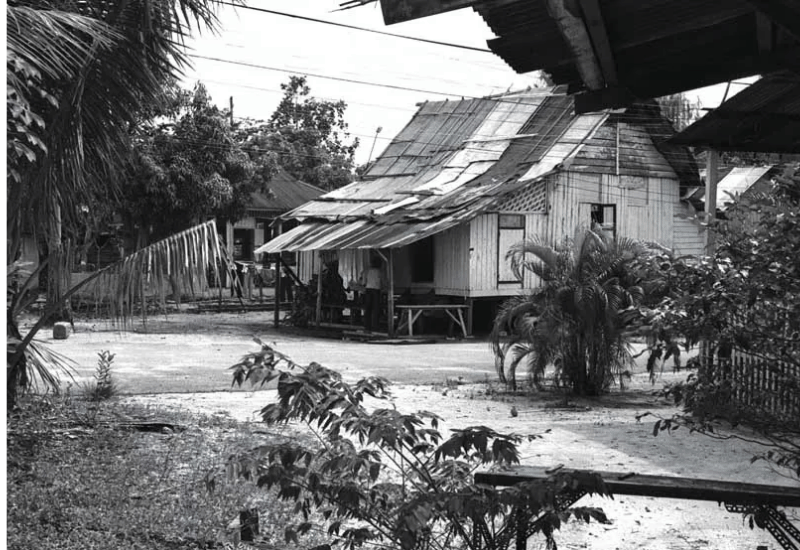
A kampong village in Singapore, mid-20th century. Image courtesy of National Archives of Singapore
So Singapore set about building them. A series of decisions, made deliberately and sustained over decades: in healthcare, in housing, in urban design, in how the state chose to treat its population's health as something to invest in rather than something to hope for. Buettner calls it the first "engineered" Blue Zone – the next frontier of aging, built on purpose rather than inherited by accident.²
What Singapore got right about Biological Capital before the word existed
Xandro Lab didn't coin the term Biocap until long after Singapore had already started building it at a national scale.
The idea behind Biological Capital (Biocap) is simple: your biology isn't a fixed inheritance. It's an asset – one that compounds when you invest in it deliberately, and depletes when you don't. Most people, and most places, treat their biology like a current account. Spend today, hope for the best tomorrow.
Singapore, without ever using the word, did the opposite. Decades before "longevity" became a consumer category and long before self-experimentation turned into a hobby, the country was already applying the same discipline to its population's health that a portfolio manager applies to a fund – not through any single dramatic intervention, but through the unglamorous, compounding work of consistent policy, applied over time.
What Singapore built: four policy levers
Preventive healthcare access
Singapore's national approach to aging didn't wait for diagnosis. Screening, health monitoring, and active-aging programs are built to start from age 40 – treating midlife as the point of intervention, not the point of decline.
Urban design that makes movement the default
Walkability, public transit, and green space weren't added after the health data made the case for them. They were built into Singapore's modern urban design as the city took shape – infrastructure that makes an active daily life the default, not a discipline someone has to maintain against their environment.
When your built environment supports movement rather than resisting it, the compounding happens without a personal trainer or a step-count app.
Housing policy that protects social infrastructure
Grants and planning that keep aging parents physically near their children aren't framed as sentiment. They're infrastructure – the kind of social proximity that, in the other five Blue Zones, showed up as inherited village life.
Singapore built the same outcome through policy instead of tradition. Decades of longevity research across every Blue Zone population point to the same finding: social connection isn't a nice-to-have. It's a biological input, as real as nutrition or sleep.
Medical and research innovation
This is the newest lever, and arguably the most consequential for the next generation. Singapore has become a genuine hub for longevity and geroscience research – the National University of Singapore's Academy for Healthy Longevity, A*STAR-backed R&D, and a clinical trial center dedicated specifically to translating aging research into practice.
It's not a country consuming other people's longevity science. It's increasingly a country producing it.
XANDRO Lab's own research partnerships with NUS and Duke-NUS sit within this ecosystem – part of a broader national commitment to treating longevity as something to be studied rigorously and applied precisely, not marketed loosely.
None of these levers is dramatic on its own. That's the point. Biocap, at any scale – a nation's or a person's – rarely compounds through one decisive act. It compounds through consistency, applied for longer than anyone expects to have to wait.

Xandro Lab's research ecosystem across Singapore. Image: Xandro Lab
The next frontier: from lifespan to healthspan
The numbers above are a genuine achievement. But the study published in The Lancet Public Health in July 2026 reveals what they leave unsolved.
Led by the Institute for Health Metrics and Evaluation and co-authored by researchers at NUS Medicine, the Global Burden of Disease analysis tracked 204 countries from 1990 to 2023 and measured not just how long people live, but how many of those years are lived in good health.¹ The difference between the two – what researchers call the morbidity gap – is the number of years a person can expect to spend with illness or disability.
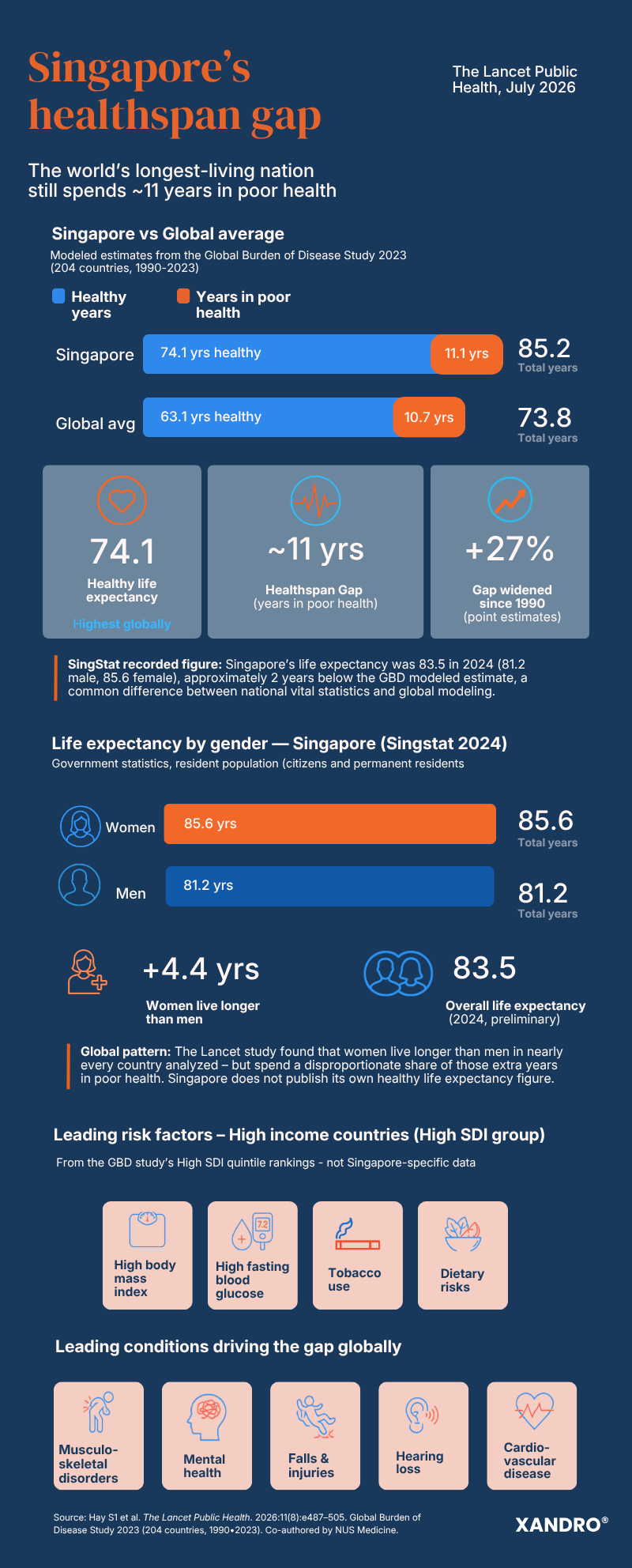
The study's modelled estimates place Singapore at the top of both rankings – with a life expectancy above 85 and a healthy life expectancy of 74.1 years, the highest on the planet. But the gap between those two numbers is roughly 11 years, and point estimates suggest it has widened by about 27 percent since 1990.¹
Singapore's own government statistics record life expectancy at 83.5 as of 2024.³ The study's estimate runs about two years higher, which is common in global modelling exercises that use different methodologies from national vital registration. Either way, the trajectory is extraordinary – and the gap between total years and healthy years is the issue both sets of numbers leave unresolved.
In other words, Singapore has become remarkably good at adding years to life. It has not yet closed the gap between years lived and years lived well.
The gender pattern
The study also confirms a pattern found in nearly every country analyzed: women live longer than men, but spend a disproportionate share of those extra years in poor health. Singapore's own statistics reflect the same gap – life expectancy for women is 85.6 versus 81.2 for men.³ Globally, the conditions driving the disparity are largely musculoskeletal and mental health conditions that disproportionately affect women in later life.
How this compares to global figures
That gap is not uniquely Singaporean. It widened in 203 of the 204 countries in the study. Globally, people now spend an average of 10.7 years in poor health, up from 8.8 years in 1990.¹ The conditions driving it are not dramatic or acute – they are musculoskeletal disorders, mental health conditions, hearing loss, falls, and metabolic disease. The slow, compounding erosion of function that most people notice only when it has already taken hold.
Among high-income countries – the peer group Singapore falls into in the study – the leading risk factors driving the gap are high body mass index, high blood glucose, and tobacco use, followed by dietary patterns.¹
The study frames the challenge plainly: for high-income countries like Singapore, the next frontier is not to add more years, but to ensure those years are lived in good health.¹
Singapore night view. Image: Mark Baldovino/Pexels.com
Sixty-one years since independence, and counting
Singapore's story is worth celebrating for what it proves. A nation with no inherited longevity advantage added two decades to its life expectancy in a single generation – through consistent, deliberate investment in the conditions that let biology compound. That's a proof of concept at the scale of six million people.
The Lancet data shows what comes next. Living longer is now the baseline. Living well across those years – closing the healthspan gap – depends on the same kind of discipline applied personally: managing metabolic health, protecting cognitive function, staying structurally resilient, investing in sleep and stress recovery before the returns start to diminish.
That's what building Biocap looks like in practice. Not a single intervention. Not a trend. The same patient, compounding discipline that turned a young nation into the world's longest-living one – applied to your own biology, starting now.
Sixty-one years in, Singapore's story is still being written. So is yours.
Build your Biocap.
Related reading
→ What Is Biocap? The Framework Behind XANDRO Lab
→ Your brain is your longest-running investment: Why cognitive decline isn't inevitable
→ Still Tired After 8 Hours? The Science of Deep Sleep Quality vs Duration
→ Protocol X® – The Flagship Biocap Protocol
Frequently asked questions
Is Singapore really a Blue Zone?
Yes – in 2023, longevity researcher Dan Buettner added Singapore to his Blue Zone list, making it the sixth. It's worth noting this is a popular-science designation by the Blue Zones founder, not a peer-reviewed epidemiological classification. What makes it significant is that Singapore is the only Blue Zone Buettner describes as "engineered" rather than inherited through centuries of tradition.
Why do people in Singapore live so long?
Singapore's life expectancy rose from about 63 in 1960 to above 83.5 today – a shift driven by deliberate national policy rather than inherited culture. Four factors stand out: preventive healthcare that begins at midlife rather than after diagnosis, urban design that makes daily movement the default, housing policy that keeps families physically close, and a growing investment in longevity and geroscience research. No single lever explains it. The consistency across all four, sustained over decades, is what moved the numbers.
What is the morbidity gap?
The morbidity gap is the difference between how long you live and how many of those years are lived in good health. A July 2026 study in The Lancet Public Health estimated that Singapore has the highest life expectancy in the world and the highest healthy life expectancy (an estimated 74.1 years), but the gap between total lifespan and healthy years – roughly 11 years – has widened by about 27 percent since 1990 based on the study's modelled data.
What is an engineered Blue Zone?
The term comes from Dan Buettner, who distinguishes Singapore from the original five Blue Zones (Okinawa, Sardinia, Ikaria, Nicoya, Loma Linda). Those five earned their longevity status through inherited diet, culture, and community structure accumulated over generations. Singapore built comparable outcomes through deliberate policy decisions – in healthcare, housing, infrastructure, and research – within a single generation. Buettner calls it "Blue Zone 2.0."
What is Biological Capital?
Biological Capital – Biocap – is the framework Xandro Lab coined to describe the investable biological resource that determines how you age, perform, and recover. It's built across five biological assets: cellular energy, cognitive function, performance and recovery, longevity pathways, and structural resilience. The core principle is that your biology compounds when managed deliberately and depletes when neglected – the same principle Singapore applied to its population's health at a national scale, decades before the term existed. Supplements are one input among many; the foundational investments are sleep, nutrition, movement, stress management, and consistent medical care.
How is Singapore different from the other five Blue Zones?
The other five Blue Zones developed their longevity advantages organically – through ancestral diets, geographic isolation, inherited community structures, and cultural practices passed down over centuries. Singapore had none of these inherited structural advantages in 1960. What it did have – rich food cultures, kampong village bonds, deep family proximity – couldn't translate into long lives without the healthcare, sanitation, and infrastructure to support them. Its longevity gains came from engineering those conditions through policy: universal healthcare access, preventive screening from midlife, walkable urban design, housing that keeps families close, and investment in medical research. The outcome is comparable. The method is entirely different.
This article is published by XANDRO Lab for educational purposes. It is not intended to diagnose, treat, cure, or prevent any disease. Always consult a qualified healthcare professional before starting any supplement, particularly if you are taking prescription medications, managing a health condition, or are pregnant or breastfeeding.
Sources
-
- Hay SI et al. Global, regional, and national trends in the morbidity gap and contributing diseases, injuries, and risk factors, 1990–2023: a systematic analysis for the Global Burden of Disease Study 2023. The Lancet Public Health. 2026;11(8):e487–505. DOI: 10.1016/S2468-2667(26)00098-8. | Peer-reviewed systematic analysis (204 countries, 1990–2023; co-authored by NUS Medicine).
- Buettner D. The Blue Zones: Secrets for Living Longer. National Geographic, 2023. Also: Live to 100: Secrets of the Blue Zones (Netflix, 2023). | Popular-science designation (Singapore as sixth Blue Zone; "engineered" framing).
- Singapore Department of Statistics (SingStat). Life expectancy at birth, 1960–2025. | Government statistical source.
- National University of Singapore, Yong Loo Lin School of Medicine. Academy for Healthy Longevity; NUS Medicine Geroscience Clinical Trial Centre (opened late 2025). | Institutional source.
- Agency for Science, Technology and Research (A*STAR). Longevity and geroscience R&D programs, Singapore. | Institutional source.
Tags: